Sign! Sign! Everywhere a sign!
 |
Red Mustards, Purple Asparagus and Daffodils adorn Meg's
Garden this early spring!
|
Now that Spring is here, we need more signs in the garden
that inform visitors about who we are and what we are trying to
accomplish. What about this one? (We'll take your suggestions, really!)
Welcome to Meg’s Community Garden, the community
hub of the James Baldwin Outdoor Learning Center, a sustainable outdoor
learning environment designed to engage our senses and our communal need to
grow and eat organic and locally grown foods, surround ourselves with the
beauty of nature and learn how to live sustainable and healthier lives.
Most of the trees here in our edible forest are alive and will be willing to
share their fruits when they are ready. We are being very mindful of what
to plant both in and outside of our community garden. Many nearby plants
surrounding our fruit and nut trees are good companions and should also be
respected. Please help care for our fruit, nut and other trees by
carefully observing and showing others how to look at nature. You are
free to admire buds and branches and fruit, but please, be careful how you touch! without
permission. If you want our permission,* If you feel like gardening, then please volunteer or visit during
our open hours, every Thursday, from 3 until dusk.
*Thanks Sung for the suggestion. It did sound a bit authoritarian. It's just that, as you know, we've had over a dozen trees stolen and we've seen our share of broken branches and knocked over young trees. So I've taken out the permission part.
 |
New Trails and scenes from Meg's Garden Opening Day, April
4, 2019
|
Opening Day
On Thursday, April 4, 2019 we held our opening day at Meg's
Garden and started a new tradition. Parker and Jack Gambino brought folk
songs and there was JBOLC Place Based Garden Tea, Apple Spice Cake, Apple
Butter and Sourdough Bread - all home made!
Spreading Permaculture
We have been trying to negotiate between the
administration of our three campus high schools (DeWitt Clinton, Bronx
Collaborative and World View), the School Construction Authority and Adam’s
European Construction in order to apply a mixture of seeds that include perennial
herbs, root crops and clovers* instead of turf grass to remedy and restore the
soil in the former construction staging area adjacent to Meg’s Community Garden
and Edible Forest. Adam’s European Construction, who are wrapping
up their project on campus, are leaving soil that is heavily compacted and
abused by heavy trucks and machinery. Using permaculture inspired
practice, this area can be remedied in a way that requires little to no
maintenance, and so, no wasted energy, no toxic chemicals and more beneficial
to healthy soil organisms, birds and pollinators. The benefits of this
method cannot be overstated.
 |
Monarch on Aster, Meg's Garden 2018.
|
* We have offered the following list of seeds most of which
we have already have from last year or have purchased: Rye, Buckwheat, Parsley,
Mint, Creeping thyme, Lemon balm, Catnip, Lavender, Sage, Oregano, Chamomile, Chives,
Comfrey, Alpine strawberry, Echinacea, White clover, Red clover, Parsnip,
Turnip, Horseradish, Oilseed Radish and Daikon Radish.
We feel like we are offering a much more efficient and environmentally sound
solution to a persistent problem, however, not without facing push back and a
reassertion of the status quo. Some want to “return the grounds to how
they were before the construction.” At worst, this could mean an
all out effort to establish an unnatural lawn through the use of chemical
fertilizers, herbicides and pesticides. We object to this approach on the
grounds that we presently grow an abundance of food on our school campus
without the use of any chemicals. We do not want to see a community food
source be tainted or even poisoned by the use of toxic chemicals on the same
school grounds. We also believe that if the SCA initiates our protocols for
restoring the environment in a more sustainable earth friendly way it will be a
benefit other schools throughout the city. We are willing to extend our
edible forest to the west of Meg’s Garden and we will be very thankful if the
SCA supports our efforts to remedy and restore the soil there as quickly as
possible. SCA will have have our full support if they would like to explore or replicate
our method to restore other areas of campus disturbed by a three year
construction project. Gardeners are constructors too; we build places for
human beings, where wildlife is lured and welcomed.
Programming with High School Classes
Presently we are working with DeWitt Clinton High School
Science teacher Caitlyn Maceli to supplement PLTW (Project Lead the Way)
Environmental Sustainability Curriculum for her students with direct hands on
practice and experience in Meg’s Garden. We’ve outlined our overall
goals, desired outcome, methodology and materials as follows:
OVERALL GOALS OF JBOLC OUTDOOR EDUCATION:
HOLISTIC SUSTAINABILITY
for the happiness of Soil, Soul and Society
1. To learn to grow sustainably, efficiently and ethically
2. To nurture sensibility
3. To nourish personal responsibility and communality
4. To be connected to nature and be a steward
5. To understand “pattern” in nature
6. To practice all of the above in the context of
maintaining our school campus, outdoor garden/learning spaces and neighboring
public areas
OUTCOMES
Each student will succeed at and gain skills in the
following areas:
1. Helping to maintain school gardens
2. Designing and Growing their own garden space by planning,
planting, maintaining, harvesting, preserving/cooking in a sustainable way.
3. Sharing with parents, teachers, friends, and community.
4. Taking care of school environment and surrounding
neighborhood.
5. Caring for Trees and other plants
6. Building green infrastructure
7. Participating in recycle/zero-waste efforts including
those initiated in student cafeteria
8. Beautifying the surroundings (planting flowers, picking
up trash, building walkway/trail, signage)
9. Teaching (and learning) by connecting and sharing what
and how they’ve learned with younger students from neighboring and local
elementary schools
10. Presenting and tabling at signature events for teachers,
friends, classmates, parents and community culminating in Spring Banquet/
Sustainability Expo to be held in May or early June of 2019 - (simultaneous
with Unity in the Community?)
METHODOLOGY
Ours project-based curriculum aims to be fun, hands-on, and
engaging for all.
We are guided by sustainable permaculture practices that are
seasonal, site specific, ecological, resource conscious, ethical, organic and
non-toxic.
We will encourage students to learn from each other and from
everything they notice in nature (even a weed has so much to teach!).
We are establishing an outdoor classroom environment in
contrast to what students experience indoors and so we will emphasize close
observations of nature in nature and direct action through activities that
directly support our sustainable and edible landscape.
We will invite guests, teachers, professionals, and
experienced community members to share their knowledge and expertise about
gardening and permaculture practices.
We will inform students on continued progress on our ongoing
garden/site design.
Our assessments will also be holistic and qualitative,
focusing on participation, curiosity, initiative, commitment.
MATERIALS
We will use a variety of garden and farming tools and work
mostly around soil, compost, plants of all kinds. Additionally, whenever
it is possible, we will use what’s available and already out there in the
environment (sticks, branches, plants, found materials and so on) and
recycled/recyclable/compostable materials. We aim our project to be
completely zero waste.
★ ★
★
★
★
★
★
★
★
★
★
★
★
★
★
★
Next year we hope to expand our offerings to engage other
high school classes in the building on a regular basis. This year we are taking the time to develop
curriculum. However, if you wish to
schedule a class visit or discuss how your students can be involved in our
programming, please reach out to us.
 |
Aaron Burns of World View H.S.
|
Like last year, we continue to work with a number of
individual students who comprise the JBOLC Green Team in coordination with the
Bronx Transition and College Access Center providing hours for students to work
in school during their lunch periods doing cafeteria recycling and after school
on Tuesdays and Thursdays.
Trailer Donation
Adam’s European Construction has done a great job fixing or
replacing brick and mortar and making the Castle on the Parkway look new
and fresh again. Knowing that some of their construction obstructed our
school garden, they made a tremendous effort to help us keep our garden
programs going. Adam's Construction created our school's first bioswale
at the end of the lower parking lot. They helped us find and locate
boulders to barrier the bioswale, moved logs and donated leftover stones and bricks.
They have been true allies during this period of construction helping us with
their equipment and after we inquired about the future of an old trailer that
bordered Meg’s Garden, they offered it to us.
 |
We admit, it is an eyesore in this location - the fence used
to secure it is hideous.
|
We think that after a conversion, the trailer might best function
as an organizational headquarters, workspace and storage unit. We have
identified what we feel would be a perfect location away from the street and
away from sight. We can raise the funds and elicit volunteer help for a
makeover. After the trailer is moved we can begin remodeling and painting
the outside so that it will fit into the existing landscape.
 |
| Imagine with us the possibilities of a
make over! |
Progress on The Welcome Table
We are one step closer to building the Welcome Table from the 90 +
old oak tree lumber that we’ve been curing on site.
We have a miller! Robert Rising of City Slab in
close-by Yonkers consulted on our pile and can bring over two mills for one day
to finish it all. Some of the timber can be shaped immediately into
garden benches, while the best of the lengthier and straighter boards can be
further cured and kilned to become the lumber used to create the set piece of
our project, the Welcome Table.
Mr. Rising also suggested that the trailer be paneled with
oak pieces he can make and that remnants might be used to make smaller craft
pieces like cutting boards that might be used as fund-raisers. We will
also use remnants to create our series of garden signs.
Briefly, for now...
Cafeteria Recycling
Our goal for this school year is 6,000 lbs or 3 tons so we are a little less
than half way there with only two months of school to go. With that said,
we are already surpassing last year’s goal of 1 ton.
Cafeteria Recycling Statistics (October 18, 2018 - April 11, 2019)
Total Plastic, Metal, Glass, Cartons, Recovered food diverted from
landfill
1414.63 lbs
Total Liquid diverted from landfill (estimated 37lbs per
day) 1532 lbs
Total Diversion (MGPC and detained
liquids)
2946.63 lbs
 |
Patterns of Food Recovery - most of the apples collected
from the school cafeteria are dried or made into applesauce.
|
Total Food Recovered from School Cafeteria (mostly whole
apples or pre-sliced apple packets, hummus containers) 343.3 lbs
Total Donation to Food Kitchen (Part of the Solution,
POTS) 145.64 lbs
Total Food Transformed into dried apple snacks, cakes and
applesauce for Community Volunteers, Kitchen Staff, Custodians and Students 197.36
lbs
Our goal for this school year is 6,000 lbs or 3 tons so we
are a little less than half way there with only two months of school to
go. With that said, we are already
surpassing last year’s goal of 1 ton.
We are happy to announce that we have a new World View High
School Zero Waste Pledge Green Team under the direction of teacher Deborah
Reich that is now in command of recycling during period 5. This is a great sign! Now, for the other two campus schools to step
up!
Green Infrastructure Internship
In partnership with The New York State Water and Soil
Conservation District, we will be offering green infrastructure internships for
students from any campus high school. Interns will learn how to create
and maintain green infrastructure as we work in cooperation with The New York
City Department of Transportation and the NYC Department of Environmental
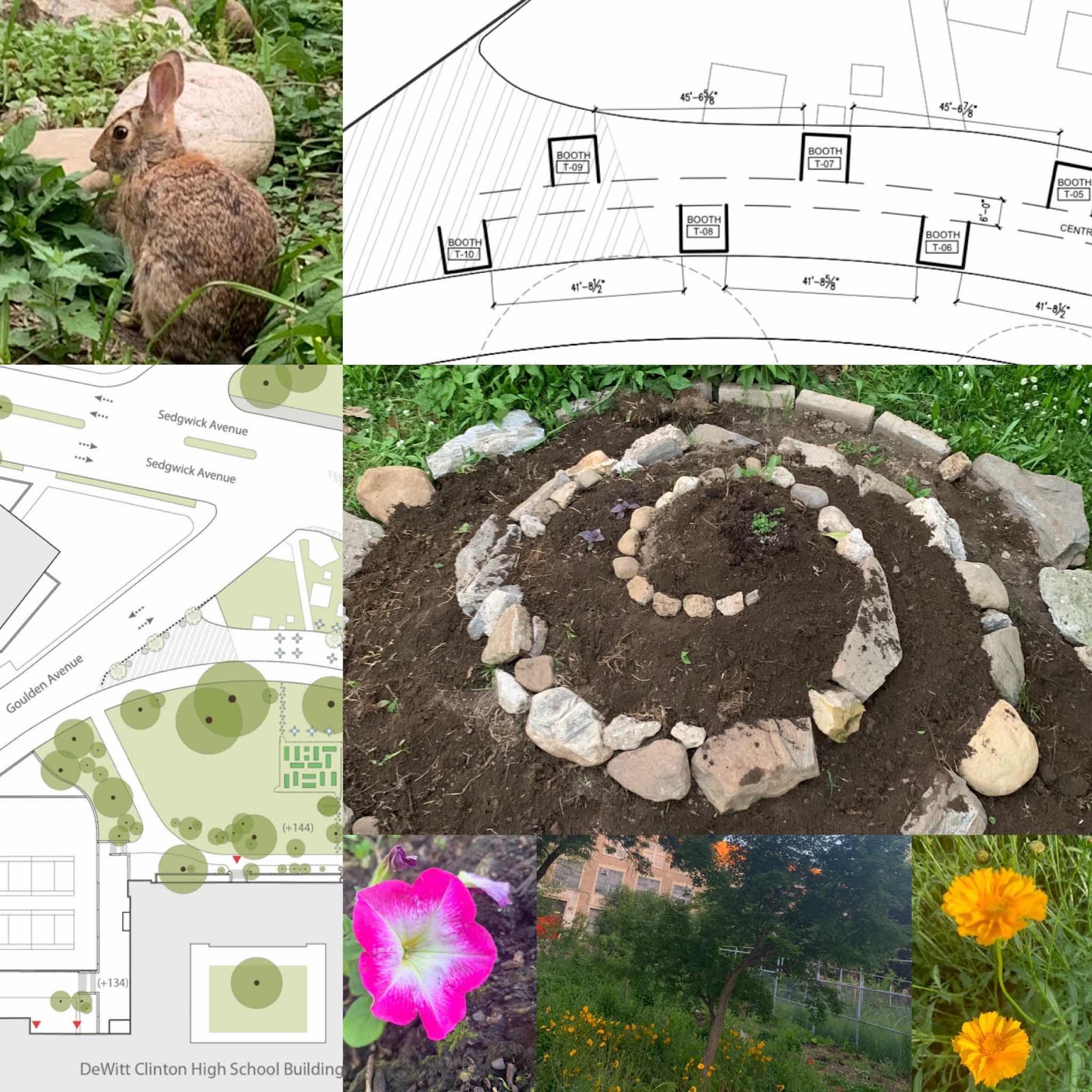
Protection to install a pollinator garden on the meridian adjacent to
Meg's Community Garden on the other side of the unused access road. Green
interns will also be incorporating green infrastructure features such as paths
and swales on our school garden sites and helping to manage community composting
and other environmental projects around campus. Interns will be provided
a stipend and an opportunity to stay on as a JBOLC volunteer. This spring
we are simultaneously developing three sites in and around campus and building
a green house.
Please share your comments