Saturday, June 27, 2020

JBOLC Brings New Farmers Market to the Bronx while Compost Education is Threatened

The blog formerly known as Witt Seminar on Sustainability in Schools will now be called
James Baldwin Outdoor Learning Center
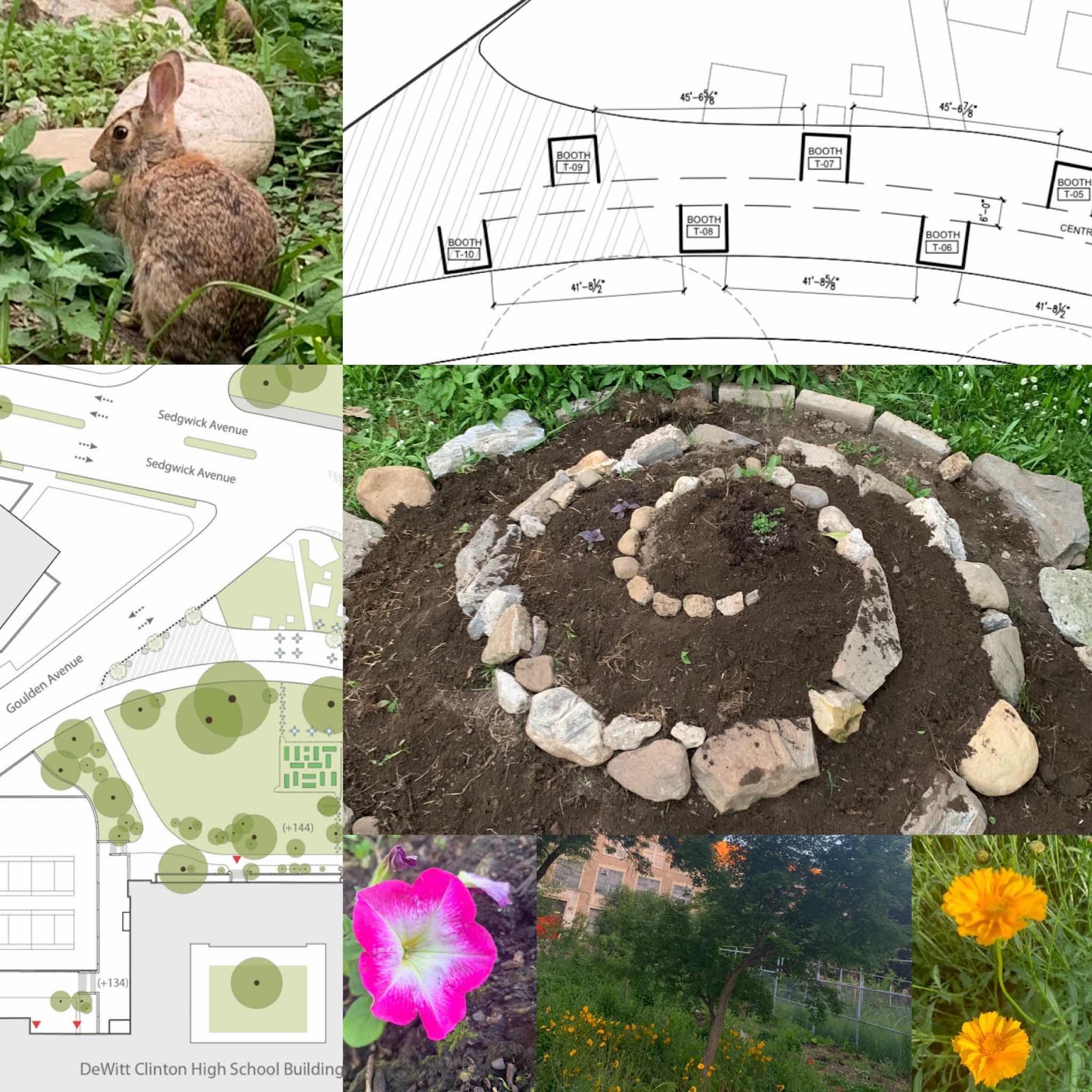

Special shout out to Linda, Jose, Matt and Julia of Marpillero Pollak Architects for their wonderful and prompt help with drawings that we presented to CB 8 - professional all the way!!


    We are happy to share the news that the Traffic and Transportation Committee of Community Board 8 unanimously approved our SAPO (Street Activity Permit Office) application to operate a farmers market on the sidewalk and unused roadway adjacent to Meg’s Garden near the intersection of Goulden and Sedgwick Avenues and West Mosholu Parkway, So. (north side of DeWitt Clinton High School Campus).   The JBOLC (James Baldwin Outdoor Learning Center) Garden Community Farmers Market will operate starting on August 8, 2020 and ending October 31, 2020 from 8:00 am to 3:30 pm (with the hours for market customers most likely from 9:00 am to 2:00 pm to allow for set up and break down).  Farmers and vendors from around the city and state will converge to sell their fresh, locally grown and produced fruit, vegetables, herbs and other garden and farm products.  Our mission starting now will be to gather the farmers and merchants to our market.  

I’ve always admired when forces converge to bring about meaningful and just change.  And as each person is a force in nature, it has been a network of friends, supporters and loyal day in and day out volunteers and, of course, the force of nature itself, plants and everything that grows that have converged to make this moment of change.  The time has come to bring more fresh healthy food to an area at a meeting place connecting Norwood, Kingsbridge and Van Cortlandt Village with Bedford Park close by.   Our site at the garden community hub of the James Baldwin Outdoor Learning Center on the DeWitt Clinton High School Campus seems perfect to foster a diverse, integrated and just community built around the access to, enjoyment and sharing of locally grown, fresh, nutritionally dense food at a time when our New York City communities need to recover, grow stronger and healthier.   

We are motivated by an unprecedented need to grow more food!  James Baldwin Outdoor Learning Center is collaborating with Bronx Green Up and community gardens across the Bronx to establish a series of food hubs to help meet the urgent needs anticipated by everyone who wishes to stay healthier by eating more locally grown, fresh and nutritiously dense food.   Each "hub" will be comprised of a cluster of community gardens from different neighborhoods that will collectively grow food for a local community farm stand or emergency food provider.


Perennial herb harvest Spring 2020.


The uncertain times that we are experiencing demand greater resiliency.  The availability of healthy and nutritious food in a community with unequal access is an issue of justice.  As James Baldwin wrote in The Fire Next Time, “It will be a great day for America, incidentally, when we begin to eat bread again, instead of the blasphemous and tasteless foam rubber that we have substituted for it.”


What was once the patio in front of James Baldwin's study in his house in Saint-Paul de Vence, with his writing/reading table. Photo courtesy of Magdalena J. Zaborowska from Me and My House: James Baldwin's Last Decade in France  (no copyright infringement intended)

In the midst of, and hopefully soon in the wake of this unprecedented global pandemic coupled with an unprecedented global demand for justice and freedom from institutional, authoritarian and militaristic racism and violence, it is time that we begin to eat bread again.  There is what has been called a slow violence that will never be as sensationalized in the news but that is enacted in every case of chronic, diet-related illness and diseases and their destruction in our communities.   There is and will be an increasing need to address underlying health issues that impact the health and welfare of our Bronx families making them more vulnerable.  There were more cases of Coronavirus in the Bronx than in any other borough of New York City.  Accessing fresh, local and affordable healthy vegetables and food products is a human right and a logical first step towards a better and just world.    

James Baldwin in the garden of his home in Saint-Paul de Vence.

If we are anything now, it is because community-based compost is at the root!

If we are anything now; if we are managing an exceptional and unique educational resource, a thriving, local paradise of bio-diversity, home to hundreds of species of plants, birds, animals and insects and stopping off point for hundreds more – yes, arrays of birds – goldfinches and killdeers - worthy of any far off country meadow, hawks, swallows and bats circling at their different times, a seemingly oblivious family of rabbits – all right outside of our school’s doors; if we are engaging sustainability and science students and student interns into the study of permaculture and sustainability – that is, the studied observation and design of landscapes that take best advantage of what nature does best: grow and produce abundance; if we are feeding community volunteers and their families local, fresh, organic and nutrition packed food and donating surplus to contribute healthy, fresh and nutritionally dense food to community kitchens and food pantries where canned goods and nonperishables reign; if  we started from a modest school garden and grew our garden community each and every year for ten years now to include Meg’s Garden and Edible Forest with over 50 fruit and nut trees and if we continue to reclaim grounds scourged by the school’s recently completed 5 year construction project; if we then, based upon our apparent success at transforming and beautifying our school grounds founded the viable 501 (c) 3 non profit organization called the James Baldwin Outdoor Learning Center named after the legendary American writer and icon and DeWitt Clinton High School alumnus and if our mission is to strive for inquiry and project-based solutions at the juncture of food, environmental and social justice; if we are at all at or approaching the forefront of an environmental education movement at a critical time in history when our entire global population is incentivized to reassess, revise and embrace a caring relationship with nature as our only true means of survival – we cannot live without what the natural world yields to us – oxygen, nourishment, sustenance; if we are what we say or just wanna be or should be (you decide!); If we are anything now, I can truthfully say, compost is at the root!


Ursula Chanse and Kadeesha Williams of Bronx Green-Up and NYBG bringing a load of compost to Meg's Garden and Edible Forest in May, 2020.

Perhaps you think I exaggerate, but it is true that NYC Compost forms the very foundation of our success, for a number of reasons:

First and foremost, compost, itself, contributes fertility to urban soils.   In other words, if it were not for soil made fertile with compost, we would not be able to grow abundantly - let alone produce a surplus - of healthy fresh fruits and vegetables to share with our garden community.  While rural farms have greater access to manure from animals, for city gardens and farms, compost is the most essential and available fertilizer.

While we are grow our edibles in raised beds and on soil that has been amended with compost for years, plants growing in soils that are acidic are more likely to absorb any toxins that might be present in the soil.  This is quite important when attempting to grow food in urban environments.  There are innumerable chances that any urban soil can contain toxins from the amounts of cars, trucks, and buildings discharging polluting exhaust, exacerbated by heat island effects and micro-climates.  Compost acts as a great purifier, as it helps neutralize acidic soils and lessening soil contamination wherever it is placed.  By widely using compost we are automatically helping to detoxify our urban soils, creating a balance in our environment and making our gardens and parks safer for not only our most vulnerable citizens but for every child, pet and creature.


Profile in herbs grown at Meg's Garden, Spring 2020.

Compost is not only the beginning point of fertile gardens and safer soils that produce healthy vegetables it is also the endpoint of a sustainable social practice.  Rather than throwing our food scraps in the garbage, where it will be hauled off (at the cost of emissions and a greater carbon footprint and thrown into landfills to further putrefy our earth and air with toxic sediment and methane, using food scraps to make compost is a win-win situation.  The Compost Project is one of the most coherent and effective means, already in action, not merely a plan, that helps meet the goals of PlaNYC 2030.  Diverting organic matter out of the waste stream and back to our communities where it brings soil fertility, enhanced growing operations, fresh healthy and nutritious food like we grow in our gardens is one of the most sensible city policies on the environment ever enacted.

We are an official Department of Sanitation food scrap drop off site, though our operation has had to be suspended because of the Coronavirus Pandemic.   We relied upon our neighbors and community volunteers to contribute to our compost system where we make compost to apply to our plants and trees and amend our soil.  But we also received deliveries of compost made and distributed by the Department of Sanitation.  We are essential partners with this city agency – we are in effect, the clients of a city program.  We rely on the Department of Sanitation and they rely on us.  Severing this relationship is also severing a vital relationship between the city and each and every community and school garden that supports its efforts to lessen the city’s carbon footprint.  We need so much compost to continue to function as a prosperous community food source!  


This year marks the 10 year anniversary of the beginning of our project - here, students of the Witt Seminar assemble on the empty ground of what was to become The Clinton Garden in late Winter 2010.

Literally, the New York City Compost Project is a part of our origin story.  When we first started our modest school garden, the Clinton Garden, on the campus of DeWitt Clinton High School in 2010, we knew we would provide a service to society by creating a demonstration garden to teach young people where real food comes from.  The Bronx was ranked as the least healthy borough of New York City with elevated rates of obesity, diabetes, heart disease and other chronic illnesses that coincide with poor diets.  I was an English teacher leading a class project in an elective class on Activism.  Though I was born into a family that included my Uncle John, a small-scale dairy farmer in Connecticut, my days on the farm and in the family garden were a distant memory when I first committed myself to maintain and grow our school gardens.  I didn’t know where to start. 


Compost Guru Jodie Colon and Urban Farming Legend Karen Washington at the Opening Ceremony,
The Clinton Garden, Spring 2011. 

It was Jodie Colon and the New York City Compost Project in The Bronx that offered the kind of support that we needed.  It is the typical situation of teaching the villager to fish.  The New York City Compost Project offers the Master Composter Training Course that perhaps more than any other experience, propelled our project forward.  One might have thought that the first step I would take to hone my skills as a gardener would be gardening workshops, and sure enough I did take plenty of those offered by GrowNYC, GreenThumb, and Bronx GreenUp.   The Green Thumb Grow Together Conferences offered a valuable education each year and it was led by people I grew to identify with, community members who generously share their first hand knowledge and experience.  But it was Jodie’s Master Composting Class that first made me feel like an expert.  The Master Composter Course gave me a sense of purpose and professionalism, a deep respect for the work of the Sanitation Department and their efforts to think beyond the box – or the trash can!  The course inspired me to first think in terms of projects that were scalable and we’ve been scaling up ever since.   I also came to the basic understanding that before growing anything, we needed good soil and compost improves all soils.   

 
Clinton Garden Harvest (circa 2012)


What distinguishes things done for the public good rests in the word public, especially when contrasted with its opposite, personal.  What is done for the public or in public is visible.  One might even say that what is made public wants to be seen – it is done in public and so it is visible.  The NYC Compost Project and Grow NYC and other city partners provide to the public a service that results in greater health and beauty.   It is visible, it is evident, it is public.   It is visible in the health of our gardens and our citizens and all who rely on a more local source of well-being, our communities themselves.  Community Compost is a success story in a long struggle to transform the city we all love into a more green, sustainable and healthy home.   This is not the time to abandon such success or undermine what is so foundational a public resource!


We consider ourselves essential workers at JBOLC!  Please support our efforts to grow more food!  
 

Please share your comments

Friday, April 12, 2019

Proliferation of Spring!


Sign! Sign! Everywhere a sign!


Red Mustards, Purple Asparagus and Daffodils adorn Meg's Garden this early spring!


Now that Spring is here, we need more signs in the garden that inform visitors about who we are and what we are trying to accomplish.  What about this one? (We'll take your suggestions, really!)

Welcome to Meg’s Community Garden, the community hub of the James Baldwin Outdoor Learning Center, a sustainable outdoor learning environment designed to engage our senses and our communal need to grow and eat organic and locally grown foods, surround ourselves with the beauty of nature and learn how to live sustainable and healthier lives.  Most of the trees here in our edible forest are alive and will be willing to share their fruits when they are ready.  We are being very mindful of what to plant both in and outside of our community garden.  Many nearby plants surrounding our fruit and nut trees are good companions and should also be respected.  Please help care for our fruit, nut and other trees by carefully observing and showing others how to look at nature.  You are free to admire buds and branches and fruit, but please, be careful how you touch! without permission.  If you want our permission,* If you feel like gardening, then please volunteer or visit during our open hours, every Thursday, from 3 until dusk. 

*Thanks Sung for the suggestion.  It did sound a bit authoritarian.  It's just that, as you know, we've had over a dozen trees stolen and we've seen our share of broken branches and knocked over young trees.   So I've taken out the permission part. 
 
New Trails and scenes from Meg's Garden Opening Day, April 4, 2019

Opening Day

On Thursday, April 4, 2019 we held our opening day at Meg's Garden and started a new tradition.  Parker and Jack Gambino brought folk songs and there was JBOLC Place Based Garden Tea, Apple Spice Cake, Apple Butter and Sourdough Bread - all home made!


Spreading Permaculture 

We have been trying to negotiate between the administration of our three campus high schools (DeWitt Clinton, Bronx Collaborative and World View), the School Construction Authority and Adam’s European Construction in order to apply a mixture of seeds that include perennial herbs, root crops and clovers* instead of turf grass to remedy and restore the soil in the former construction staging area adjacent to Meg’s Community Garden and Edible Forest.   Adam’s European Construction, who are wrapping up their project on campus, are leaving soil that is heavily compacted and abused by heavy trucks and machinery.  Using permaculture inspired practice, this area can be remedied in a way that requires little to no maintenance, and so, no wasted energy, no toxic chemicals and more beneficial to healthy soil organisms, birds and pollinators.  The benefits of this method cannot be overstated. 
Monarch on Aster, Meg's Garden 2018.
* We have offered the following list of seeds most of which we have already have from last year or have purchased: Rye, Buckwheat, Parsley, Mint, Creeping thyme, Lemon balm, Catnip, Lavender, Sage, Oregano, Chamomile, Chives, Comfrey, Alpine strawberry, Echinacea, White clover, Red clover, Parsnip, Turnip, Horseradish, Oilseed Radish and Daikon Radish.

We feel like we are offering a much more efficient and environmentally sound solution to a persistent problem, however, not without facing push back and a reassertion of the status quo.  Some want to “return the grounds to how they were before the construction.”  At worst, this could mean an all out effort to establish an unnatural lawn through the use of chemical fertilizers, herbicides and pesticides.  We object to this approach on the grounds that we presently grow an abundance of food on our school campus without the use of any chemicals.  We do not want to see a community food source be tainted or even poisoned by the use of toxic chemicals on the same school grounds. We also believe that if the SCA initiates our protocols for restoring the environment in a more sustainable earth friendly way it will be a benefit other schools throughout the city.  We are willing to extend our edible forest to the west of Meg’s Garden and we will be very thankful if the SCA supports our efforts to remedy and restore the soil there as quickly as possible. SCA will have have our full support if they would like to explore or replicate our method to restore other areas of campus disturbed by a three year construction project.  Gardeners are constructors too; we build places for human beings, where wildlife is lured and welcomed.  


Programming with High School Classes

Presently we are working with DeWitt Clinton High School Science teacher Caitlyn Maceli to supplement PLTW (Project Lead the Way) Environmental Sustainability Curriculum for her students with direct hands on practice and experience in Meg’s Garden.  We’ve outlined our overall goals, desired outcome, methodology and materials as follows:

OVERALL GOALS OF JBOLC OUTDOOR EDUCATION:

HOLISTIC SUSTAINABILITY 

 for the happiness of Soil, Soul and Society

1. To learn to grow sustainably, efficiently and ethically
2. To nurture sensibility
3. To nourish personal responsibility and communality
4. To be connected to nature and be a steward
5. To understand “pattern” in nature
6. To practice all of the above in the context of maintaining our school campus, outdoor garden/learning spaces and neighboring public areas

OUTCOMES

Each student will succeed at and gain skills in the following areas:

1. Helping to maintain school gardens
2. Designing and Growing their own garden space by planning, planting, maintaining, harvesting, preserving/cooking in a sustainable way.
3. Sharing with parents, teachers, friends, and community.
4. Taking care of school environment and surrounding neighborhood.
5. Caring for Trees and other plants
6. Building green infrastructure
7. Participating in recycle/zero-waste efforts including those initiated in student cafeteria
8. Beautifying the surroundings (planting flowers, picking up trash, building walkway/trail, signage)
9. Teaching (and learning) by connecting and sharing what and how they’ve learned with younger students from neighboring and local elementary schools 
10. Presenting and tabling at signature events for teachers, friends, classmates, parents and community culminating in Spring Banquet/ Sustainability Expo to be held in May or early June of 2019 - (simultaneous with Unity in the Community?)

METHODOLOGY

Ours project-based curriculum aims to be fun, hands-on, and engaging for all.

We are guided by sustainable permaculture practices that are seasonal, site specific, ecological, resource conscious, ethical, organic and non-toxic.  

We will encourage students to learn from each other and from everything they notice in nature (even a weed has so much to teach!).

We are establishing an outdoor classroom environment in contrast to what students experience indoors and so we will emphasize close observations of nature in nature and direct action through activities that directly support our sustainable and edible landscape.

We will invite guests, teachers, professionals, and experienced community members to share their knowledge and expertise about gardening and permaculture practices.

We will inform students on continued progress on our ongoing garden/site design.

Our assessments will also be holistic and qualitative, focusing on participation, curiosity, initiative, commitment.

MATERIALS

We will use a variety of garden and farming tools and work mostly around soil, compost, plants of all kinds.  Additionally, whenever it is possible, we will use what’s available and already out there in the environment (sticks, branches, plants, found materials and so on) and recycled/recyclable/compostable materials.  We aim our project to be completely zero waste.


Next year we hope to expand our offerings to engage other high school classes in the building on a regular basis.  This year we are taking the time to develop curriculum.  However, if you wish to schedule a class visit or discuss how your students can be involved in our programming, please reach out to us. 
Aaron Burns of World View H.S.
Like last year, we continue to work with a number of individual students who comprise the JBOLC Green Team in coordination with the Bronx Transition and College Access Center providing hours for students to work in school during their lunch periods doing cafeteria recycling and after school on Tuesdays and Thursdays.

Trailer Donation 

Adam’s European Construction has done a great job fixing or replacing brick and mortar and making the Castle on the  Parkway look new and fresh again.  Knowing that some of their construction obstructed our school garden, they made a tremendous effort to help us keep our garden programs going.  Adam's Construction created our school's first bioswale at the end of the lower parking lot.  They helped us find and locate boulders to barrier the bioswale, moved logs and donated leftover stones and bricks. They have been true allies during this period of construction helping us with their equipment and after we inquired about the future of an old trailer that bordered Meg’s Garden, they offered it to us. 

We admit, it is an eyesore in this location - the fence used to secure it is hideous. 

We think that after a conversion, the trailer might best function as an organizational headquarters, workspace and storage unit.  We have identified what we feel would be a perfect location away from the street and away from sight.  We can raise the funds and elicit volunteer help for a makeover.  After the trailer is moved we can begin remodeling and painting the outside so that it will fit into the existing landscape.  

Imagine with us the possibilities of a make over!

Progress on The Welcome Table

We are one step closer to building the Welcome Table from the 90 + old oak tree lumber that we’ve been curing on site.

We have a miller!  Robert Rising of City Slab in close-by Yonkers consulted on our pile and can bring over two mills for one day to finish it all.  Some of the timber can be shaped immediately into garden benches, while the best of the lengthier and straighter boards can be further cured and kilned to become the lumber used to create the set piece of our project, the Welcome Table.


Mr. Rising also suggested that the trailer be paneled with oak pieces he can make and that remnants might be used to make smaller craft pieces like cutting boards that might be used as fund-raisers.  We will also use remnants to create our series of garden signs.

Briefly, for now...

Cafeteria Recycling


Our goal for this school year is 6,000 lbs or 3 tons so we are a little less than half way there with only two months of school to go.  With that said, we are already surpassing last year’s goal of 1 ton.   

Cafeteria Recycling Statistics (October 18, 2018 - April 11, 2019)

Total Plastic, Metal, Glass, Cartons, Recovered food diverted from landfill                                                                                                             1414.63 lbs
Total Liquid diverted from landfill (estimated 37lbs per day)       1532      lbs
Total Diversion (MGPC and detained liquids)                                     2946.63 lbs


Patterns of Food Recovery - most of the apples collected from the school cafeteria are dried or made into applesauce.
Total Food Recovered from School Cafeteria (mostly whole apples or pre-sliced apple packets, hummus containers)                                                                                         343.3 lbs
Total Donation to Food Kitchen (Part of the Solution, POTS)             145.64 lbs
Total Food Transformed into dried apple snacks, cakes and applesauce for Community Volunteers, Kitchen Staff, Custodians and Students                                                                                                                                   197.36 lbs

Our goal for this school year is 6,000 lbs or 3 tons so we are a little less than half way there with only two months of school to go.  With that said, we are already surpassing last year’s goal of 1 ton. 

We are happy to announce that we have a new World View High School Zero Waste Pledge Green Team under the direction of teacher Deborah Reich that is now in command of recycling during period 5.  This is a great sign!  Now, for the other two campus schools to step up!  

Green Infrastructure Internship 

In partnership with The New York State Water and Soil Conservation District, we will be offering green infrastructure internships for students from any campus high school.  Interns will learn how to create and maintain green infrastructure as we work in cooperation with The New York City Department of Transportation and the NYC Department of Environmental Protection to install a pollinator garden on the meridian adjacent to Meg's Community Garden on the other side of the unused access road.  Green interns will also be incorporating green infrastructure features such as paths and swales on our school garden sites and helping to manage community composting and other environmental projects around campus.  Interns will be provided a stipend and an opportunity to stay on as a JBOLC volunteer.  This spring we are simultaneously developing three sites in and around campus and building a green house. 

Please share your comments

Tuesday, September 18, 2018

More on Quasi-Retirement


What Has Taken Over

the joy of camping
or just having the time to watch the rain

(no way I’m having mofongo tonight
but sancocho will do)

the idea of quasi-retirement –
apparently retired, yes, but also qua –
being and being first
working later
outwardly

teaching can be like this and it was for me most times
though like everyone else these days
I too was forced to the script
became someone else’s teacher
though frankly that goes on
regardless

so, an informal educator
can aspire to be a teaching
artist

patches of blue in a grey roving sky
the wind, a parent of trees,
in the stationary clouds beyond these that are racing
a human eye over a resting falcon


Please share your comments

Saturday, August 25, 2018

Another Country / Magnificent Transitions Over the Course of One Year

by Ray Pultinas

This past July marks one year of my quasi-retirement after teaching at DeWitt Clinton High School for 25 consecutive years – a quarter of a century - and wouldn’t you know it, I’ve grown not only roots, but stems, fruits and flowers.  And I try to take good care of them too.  I’m learning to be ever more mindful of what plants might need – compost or mulch or moisture or light or less light, if possible, and so much more.  You might say that the plants, the buds, the flowers, and by extension, the bees, the butterflies and turquoise colored dragon flies, the worms, (especially) the mosquitos, even the rabbits (most annoyingly) are using me.  I have become their tool, but I don’t mind.   It gives me great joy to be of use and delightfully coincides with my transition from having been a formal educator to becoming a non-formal educator. 
First graders from PS 4, The Duke Ellington School who visited Meg's Garden in May.
butterfly balm
Becoming an informal educator
We are now in the third growing season at Meg’s Garden and slowly and surely the garden has attracted countless regal pollinators, beautiful monarchs and black swallowtails, golden and purple finches, squirrels, bats, opossum, rabbits (most regrettably)  - to name those we’ve personally witnessed.  But it has also attracted community: Sung Kim, fellow passionist of permaculture and gardening, has helped us increase both diversity and productivity in the garden; Laura Chevnon has donated numerous beloved plants and shares with us her gardening wisdom and skills; former Environmental Affairs Club members and DeWitt Clinton High School graduates Clarissa Reclaimier, Jocelyn Bautista, Yelissa Vasquez, Maribel Vitagliani have been studying gardening while helping to plant, water, mulch, weed, and harvest now for 6 years and are introducing the next generation, their little nieces, nephews and siblings Kylie, Seth and Paul to the garden experience.  There are so many others in our community who are helping me to learn and we are teaching each other.  We witness pedestrians stopping to admire the garden, some venture in to ask questions or sign up and some I know are about to.   We are adding to our contact list of nearly 300 community members, volunteers, supporters, guests, visitors and admirers.

Yelissa and Jocelyn with Daikon Radishes
Yelissa and Seth
This past spring, we witnessed the fulfillment of what first seemed to many, a far-fetched idea: the transition of a former chemistry lab at DeWitt Clinton High School, room 332, into a state of the art hydroponic farm.  The Sun Club Teens For Food Justice Hydroponic Farm is a reality and history was made on March 22 when Sustainability students brought the first two lugs of butter crunch lettuce to the student cafeteria making healthy, fresh, local grown produce available to all students who attend the DeWitt Clinton campus.  Students from Ms. Sun’s three sustainability classes, an ELL class called Human Impact from Bronx Collaborative that I co-taught with Ariel Nadelstern, and Work Study/TOP Program students that I supervised helped construct the systems that will now grow over 25,000 lbs. of leafy green vegetables and 9,000 lbs. of vine crops on the farm per year. The Sun Club Teens for Food Justice Hydroponic Farm is the bold fruition of our partnership with Kathy Soll, CEO and director of Teens For Food Justice.  To have witnessed a new, state of the art hydroponic farm in our nearly century old building is a dream come true.  The farm not only produces fresh produce to serve to students, but distributes its surplus to our site based Good Shepherd Food Pantry, City Harvest and directly engages students with site based, hands-on sustainability, science, nutrition, career and work training.  Many other educational, teaching and learning opportunities and are yet to be realized but have now become possible.  
First delivery to student cafeteria
Harvesting on the hydroponics farm
Inspired by the continued success and expansion of our school and community gardens, the establishment of our edible forest, our successful partnerships with Teens For Food Justice and numerous other community organizations, our being awarded an National Endowment for the Arts Work Grant and, perhaps most especially, our continued willingness and freedom to dream and commit ourselves to “making it better” we incorporated as a non profit named the James Baldwin Outdoor Learning Center on March 23, 2018.  Our mission: to strive for inquiry-based solutions at the juncture of food, environmental and social justice.  Our organization utilizes existing and planned school resources, grounds and gardens to develop programs in outdoor environmental education for sustainable living and food preparation/service.  Our goal is to build a healthier community by integrating, educating and serving students and community members, especially low income and marginalized people, in collaboration with numerous partner organizations with common interests.

The James Baldwin Outdoor Learning Center will be comprised of two hubs connected by an accessible trail with a series of program spaces that run along the trail between them.  Accessibility is essential to guarantee equal access for all students and community members presently thwarted by steep stairs and narrow automobile ramps in surroundings marked overall by prohibitively dangerous highway intersections and barriers to surrounding green spaces.   Our Community Hub will be the welcoming gateway, a destination for healthy and sustainable living, a place where neighbors can meet and learn with each other about sustainable practices that support the health and future of the earth while sharing good food and community spirit.   The School Hub will be a versatile and intimate conference, classroom, and garden space guided by an ethos of social justice, environmental justice and food justice.  Here will be the Welcome Table to memorialize the celebrated American writer and DeWitt Clinton High School graduate, class of 1942 and to promote dialogue, sharing, responsibility, and unity.

SYEP in action!
This past summer, in collaboration with Teens For Food Justice and the Transition and College Access Center, whose Bronx headquarters is now based at DeWitt Clinton High School, we hosted our first Summer Youth Employment Program (SYEP) and it was a great success.  Fifteen students rotated through three interrelated work programs either working outside in the gardens, inside on the hydroponics farm or within our community doing food justice advocacy.  We also suceeded at establishing our youthmarket in which we sold produce grown right on our campus.   We are expecting to continue the operation of our market this fall.


Could it be that we have found Another Country?


Please share your comments