… precisely at the point when you
begin to develop a conscience, you must find yourself at war with your
society. It is your responsibility to
change society if you think of yourself as an educated person.
James
Baldwin, from “A Talk to Teachers” (1963)
Sometimes it’s hard to accept the idea that change in
schools can come so slow. If you’re in
the change business, as I picture myself to be, you must have faith that the
small steps started today can and will result in something more profound in the
future. This means working not for
immediate but eventual results. Perhaps
not too much different than what teachers have always had to content themselves
with as so many students only appreciate their teachers long after they’ve left
school. As I enter my 26th
year of teaching and finish my 23rd year at DeWitt Clinton I’ve come
to realize that there are many changes that still need to happen but I'm confident that we have set into place some healthy patterns and relationships that will continue. DeWitt Clinton will endure and I’m satisfied to
continue working for its future.
Perhaps the single most dramatic change this year has been
the roll out of our school’s small learning communities. Our Principal, “Santi,” proposed this model
of reorganization in order to increase personalization – the idea that each
student has at least one teacher with whom they can have a personal and
immediate connection. Each Clinton
teacher has a small learning community. I
aligned myself with the STE2M SLC to focus my interests in agriculture
and sustainability. STEM ordinarily refers to Science, Technology, Engineering
and Math but because we also focus on the Environment we take our E to the
second power. In this my last year of teaching and for the first time at DeWitt
Clinton, I’m teaching Sustainability to three classes of 9th graders.
I'm thinking that we should try to create a detailed map somehow of the work
we’ve begun in Sustainability to help guide the team that takes
over next year. I’m hoping that what follows will be at least the start of describing the
practices we have initiated to bring meaningful and
sustainable change to our school. I finish with an invitation to join our conversation about the future of The Clinton Garden and sustainability at DeWitt Clinton High School.
Partnership with the Bronx
River Alliance to conduct plantings and invasive removal along the Bronx River
“Tremendously fun” says Gwen. “It was a long day but didn’t
feel like it” chimes in Jada. “The best
experience ever” according to Amanda. These
were some of the reactions to our trip on November 13, when students from my
Sustainability classes and members of the Environmental Affairs Club planted
over 100 trees and shrubs and removed numerous invasive species including a
monster porcelain berry vine, thus liberating a tree. Aliyah was “amazed at how free the tree
looked.” “That tree could have died, but
we saved it.” said Amanda T.
 |
| Sustainability Students saving trees from invasive species |
“The river looked so realistic and just had that ideal look of what
a river in the environment should look like,” said one student. Students were equally driven by a
profound sense of service: “it felt nice making a difference. Helping the environment is very good and we
also set a path so other schools can come and do the same thing” said Ameera.
 |
| Clarissa Recarmier of The Environmental Affairs Club (EAC). |
Mike Zamm, co-advisor of the Environmental Affairs Club and
Environmental Education Director from Grow NYC, initiated our collaboration with
Bronx River Alliance.
We are so fortunate to be mentored by this amazing organization of citizen environmentalists who are unified in their devotion and dedication to the restoration of the Bronx River, one of our borough's natural treasures. Our next collaboration will
take place on May 21.
When
sustainability students and EAC members return to the Bronx River, I predict
that for many it will be like returning to a beloved place.
Sustainability Expo Expands
to Earth Day Expo
My 9th grade Sustainability classes are centered
on project-based learning and working together to make meaningful change in our
building. This is not an ordinary class
where students might learn only remote or abstract facts or perspectives on the
world. It is also much different than
most classes because rather than studying from textbooks, we study our school
and so DeWitt Clinton becomes our textbook. In this class we do things that can
make a difference in our school and that could benefit our entire community and
yes in some ways our planet.
 |
| Sustainability student Ameera Hassan gathering data from this fall's Classroom Recycling Audit. |
I use the term “action projects” to denote the active,
hands-on nature of our learning. “Classroom Recycling” for instance involves small
groups of students surveying classrooms for paper recycling bins, reporting on
the status of the bins and placing, replacing or repairing bins.
“Pre-cycling,” involves groups of students
raising awareness about waste before it happens and helping educate peers to avoid
wasting.
After studying the films
Trashed and
Tapped it became evident that plastic has become toxic in the
environment, especially our oceans.
Unless
it is recycled, it contributes to a huge source of pollution for our
environment.
And why do people buy water
in plastic bottles when it is widely available and free from the tap?
In many instances, bottled water is sourced
from municipal tapped water, bottled and sold back to us.
Our “Pre-cycling” groups from each
sustainability class were able to distribute nearly 500 bpa-free plastic
reusable water bottles to students.
In
order to receive a free bottle, students had to sign a commitment to keep using
it.
(We acquired these bottles as second
place winners of last year’s Grow NYC’s Big Lift Contest).
This semester, some students will track down to see
how many of these water bottles are still being used.
I’d like to
illustrate how real change has resulted from our action projects. Latisha and Savannah from period 8 who call
themselves “Save Our Mother” collected signatures on a petition to Principal
Taveras to change our school’s security policy that prevents students from
bringing in full reusable water bottles. If they've brought water from home it has to be spilled before students are allowed to enter.
Though Mr. Taveras was reluctant to change the policy, a compromise was
reached and we will be installing a new filtered water bottle filling station
in the school cafeteria this spring (using our Golden Apple Award funds). Students will be able to refill their
reusable water bottles with filtered water from a water bottle filling station
in the school cafeteria.
 |
| This photograph shows plastic found in the stomach from the carcass of a
Laysan Albatross fledgling. Collected and arranged by Dr Cynthia
Vanderlip, Division of Forestry and Wildlife, Hawaii. Photograph:
Rebecca Hosking/Philosophical Transactions of the Royal Society (from The Guardian), |
Other action
projects involved compost education (educating fellow students about composting
food waste and collecting coffee grounds from offices throughout the school and
vegetable scraps from the cafeteria kitchen), up-cycling (educating fellow
students about the possibilities of using waste as a resource for the creation
of new products), cafeteria recycling (educating fellow students on how to
separate and recycle items on their lunch trays) and future building (building
a model of our school and reimagining it as eco-designed and “green”).
 |
| Sustainability students Brianna and Amanda demonstrate a worm bin used for composting food scraps. |
 |
| The First Ever Sustainability Expo offered fifteen exhibits; there will be more for this spring's Earth Day Expo. |
To celebrate and recognize our first steps towards Sustainability we hosted our “first ever” Sustainability Expo on
January 22 in the school
library. With over 400 students attending
and hundreds receiving free BPA-free water bottles and Clinton Green buttons for completing a challenging
scavenger hunt, the expo was a great success!
And what do we do with success? We
Expand it! On Earth Day, April 22, our STE2M
SLC will be hosting our First Ever Earth Day Expo featuring more action
projects, more STE2M classes and more change!
Cafeteria Recycling Educators
kick off campaign to dramatically improve our separation and recycling of
plastics (and metals and glass) from our school’s cafeteria
When we started what was to become The Clinton Garden, we
were determined, from the outset, to see it through. We knew some doubters existed, we could tell that some thought this would just be another one term project. There were also self-doubts to overcome. But quietly and patiently we began building
and adding and learning and, within a relatively short time, we had a garden we could be
proud of. We were then being congratulated for achieving the impossible: starting a beautiful, productive working garden on the campus of
DeWitt Clinton High School. This year’s sustainability initiative is to focus on establishing a recycling program in the school cafeteria; we
must remember to draw strength from our experience and determination to build
the garden. The student cafeteria
presents the biggest challenge that our green team has ever faced. I’ve been told again and again that this
won’t work, we won’t be able to change the habits of these kids. Yet, we know the situation is unacceptable, we
see the bad habits practiced there, we know already that students are more
likely to drop their cafeteria trays on the floor as bring them to one of the
blue bins to separate and recycle. It’s
hard to change the culture of the cafeteria. Whatever mess is made, it gets cleaned up. The problem is that the mess is excessive and unhealthy and worst of all, from my perspective, wasteful.
 |
| Prior to our present campaign, what was left on the cafeteria table... |
 |
| was soon to be found in the trash... |
 |
| where recyclables like cans and cartons mingled freely with food waste! |
What students have been conditioned to is “not recycling”
because for so long there has been “no recycling.” For years, there were only single
trash bins for everything.
Recycling awareness has been growing throughout our city and our nation and
more citizens are recognizing the moral obligation of recycling as an integral
part of living sustainably. And that is why sustainability must not just be learned but be practiced.
Resistance might stem from the ‘Oh, now you
you’re deciding to have us recycle,’ to a real lack of awareness of the value
of recycling especially because there is ‘nothing in it for me.’ A regression occurred in
environmental terms and we became a “single trash bin culture.”
Everything, whether it is recyclable or not,
goes into the same bin.
It all becomes
Trash!
 |
| From left, some of our Cafeteria Recycling Educators, Bryan, Jestina, Dionny, Bryana and Eduardo who helped collect over 200 lbs of recyclables from the DeWitt Clinton High School cafeteria thus far. |
But now students are slowly becoming aware that they’ve been given
a choice.
Students could be part of the
solution to a problem.
We finally have recycle
bins set up in the cafeteria and we are recycling properly, that means taking it to the curb so that the Department of Sanitation could pick it up.
We have cafeteria-recycling educators. With
the help of Laura Piraino of Grow NYC’s Recycling Champions and Toni Campopiano
and her staff from Good Shepherd, we trained twelve cafeteria educators in the
basics of cafeteria recycling as well as the interpersonal skills necessary to
be an effective cafeteria educator.
To
be effective in this business so far means outreach and patience.
The job of the cafeteria-recycling educator
is to encourage recycling, answer questions about separation, and manage the
recycle bins.
It's not to be a garbage collector or a trash picker!
 |
| From left, Some of our Environmental Affairs Club members, Madeline, Apple, Eslainy, TJ, Clarissa, and Shahana brought it out to the curb. |
Our students made history this past week when we hauled 177
pounds of recycling to the curb to be collected for the first time in recent
memory.
Of that total, 59 pounds were
contributed from the cafeteria kitchen thanks to the efforts of Paul
Griffith, who is championing the initiative to recycle plastic, metal and glass from
the kitchen.
 |
| Mr. Griffith and Dean McGuire |
To be honest, we could do a lot more recycling in
the school cafeteria. But we need more support from student, staff
and faculty. We are making the first
moves but we are currently just recycling a small percentage of what we can be
recycling. I feel that it is important
to get a recycling program up and running at our school. As a united team of recycling educators,
Environmental Affairs Club members, faculty and staff we could be finally addressing what was for so long the absence of recycling in our cafeteria. It's difficult for some students to transition from a “single trash
bin culture” to a recycling culture, but for most students it's just common sense. But this should only be the start. Our collection has already grown 5 lbs a day and is currently reaching 18 lbs. We are becoming more
mindful of the environment and sustainable. But still, we need everybody’s help.
Composting
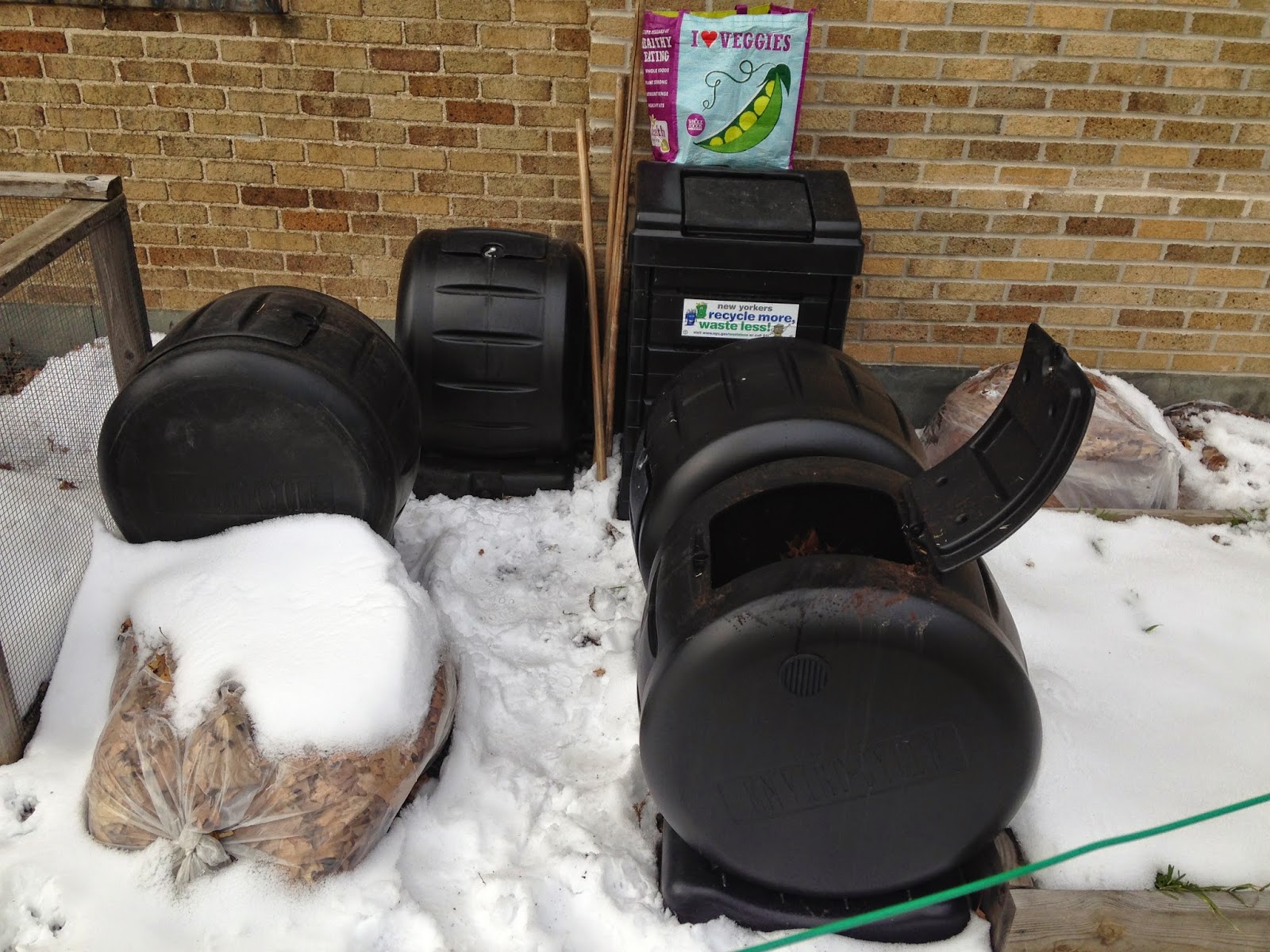 |
| We've been keeping these new tumblers busy all winter! |
|
|
|
|
The following two slides are excerpted from"The Poetics of Compost," a presentation I gave on November 23, 2014 at the National Conference of Teachers of English, National Convention in Washington, D.C.
Garden Expansion
What has to be imagined is what
can and has to be designed.
Tony Fry, from Becoming Human by Design
 |
| This past Fall we were presented this beautiful sign from our partners Bronx Green Up of the New York Botanical Garden |
It is exciting to think about
the future of a space that I have come to love and admire. I feel like a
parent of a child about to be an adolescent. I understand, the garden needs
to grow! It needs to accommodate more
people, it needs to be a place where people can gather and learn. It needs to invite the community into a
shared undertaking, to grow, to continue, to prosper, to be just. A garden is
an offering to the community of the possibility of being sustainable. It is a hope given to all that our own land
can still feed and save us. It is a
powerful statement! It is a decision to grow, garden, compost, yes, and feed a
community.
 |
| The Clinton Garden, late Winter 2015. |
The Clinton Garden is larger
than all of us. And we need to pull together as a
community to see that it continues to grow, that this still is the very start
and not the finish of an idea. I have
proposed the creation of the James Baldwin Memorial Outdoor Learning
Center (see recent posts). This would, at its most basic,
consist of a welcome table accommodating at least 35 people in a space that
provides shade and shelter. The table
itself would be a memorial and dedicated to alumnus James Baldwin. The center would be situated within an
expanded Clinton Garden environment.
 |
| First time back to the garden on March 19, EAC members from left Zoraida, TJ and Yelissa. |
Thus far, we have successfully
completed an IOBY campaign and raised $3,000 for the planning of the James
Baldwin Center. I have enlisted architect
Linda Pollak to help us construct a vision of what the garden might look like
in the future. On June 4, 2015, members of our school community along with community partners and organizations that have supported the Clinton Garden since its beginning will gather to discuss the future of The Clinton Garden. If you would like to be a part of this conversation, please email me at raypultinas@gmail.com
And please share your comments and suggestions.
 |
| Our new logo, designed by Clinton student Carlos Ramos. Let us know what you think. |


